






How do I choose the best Philippines medical university for Indian students in 2026?
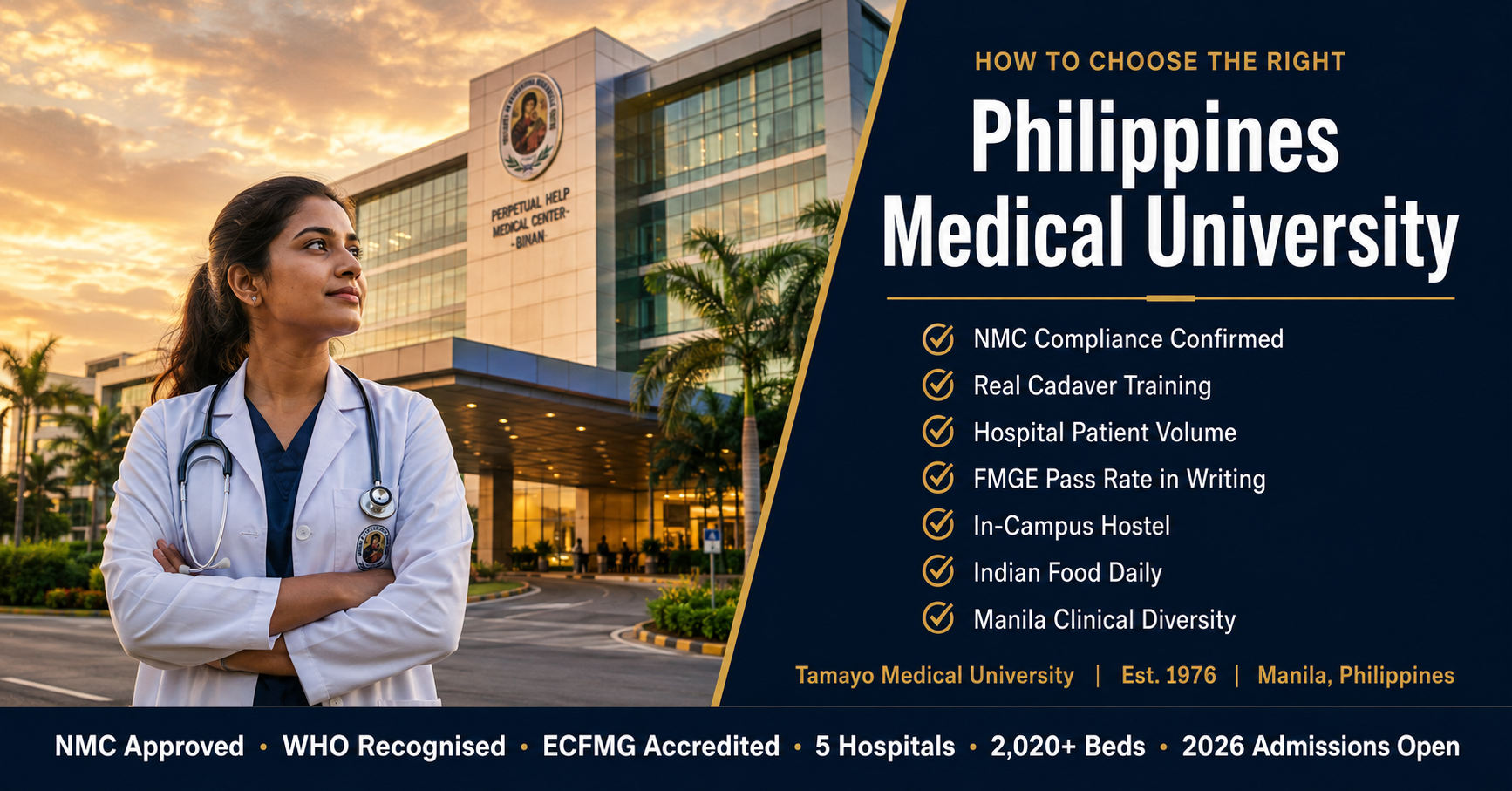
Evaluate every Philippines medical university across 7 criteria: NMC compliance confirmation (not just listing), real cadaver anatomy training, hospital patient volume during internship, FMGE pass rate in writing, in-campus vs off-campus hostel, daily Indian food availability, and Manila vs provincial location. Tamayo Medical University (UPH-DJGTMU) — established 1976, NMC approved, 5 hospitals, 2,020+ beds, Indian Chef, in-campus hostel — meets all 7. 2026 admissions open.
The Philippines is home to more than 37 NMC and WHO approved medical colleges. Over 12,000 Indian students enrol in Philippine medical programmes every year. And every year, thousands of Indian families make a decision they will live with for six years — choosing a Philippines medical university — based almost entirely on brochure claims, fee comparisons, and Google reviews.
Most of them never ask the seven questions that actually determine whether a Philippines MBBS college will produce a doctor who passes FMGE, practices confidently, and justifies the investment of the past six years.
This guide changes that. We lay out the 7 criteria that genuinely differentiate one Philippines medical university from another — not the criteria that marketing departments want you to use, but the ones that actually determine medical outcomes. And then we show you exactly where Tamayo Medical University — University of Perpetual Help, Manila — stands on every single one.
How to Actually Compare Philippines Medical Universities — 7 Criteria That Matter
Every Philippines medical university comparison article you will find on Google uses the same four criteria: fees, NMC approval, accreditations, and location. These are not wrong criteria — but they are incomplete. Two colleges can both have NMC approval and both be in Manila and still produce dramatically different FMGE outcomes for their Indian graduates.
The seven criteria below go deeper. They are the questions that experienced MBBS abroad counsellors ask when evaluating a Philippines MBBS college — the questions that most families never think to ask because no brochure or consultant ever raises them.
Work through these criteria for any Philippines medical university you are considering. The answers will tell you more than any ranking list ever could.
Criterion 1 — NMC Compliance: Which Philippines Medical Colleges Are Confirmed vs Just Listed?
This is the criterion that changed most significantly in 2026 — and it is the one most comparison articles still get wrong.
There are two distinct types of NMC recognition for a Philippines medical university:
Type 1 — NMC Listed: The college appears on the NMC India overseas medical colleges list (nmc.org.in). This is a baseline requirement. It means the college was recognised at the time of listing. It does not necessarily mean the current curriculum has been verified against NMC’s 2021 FMGL Regulation requirements.
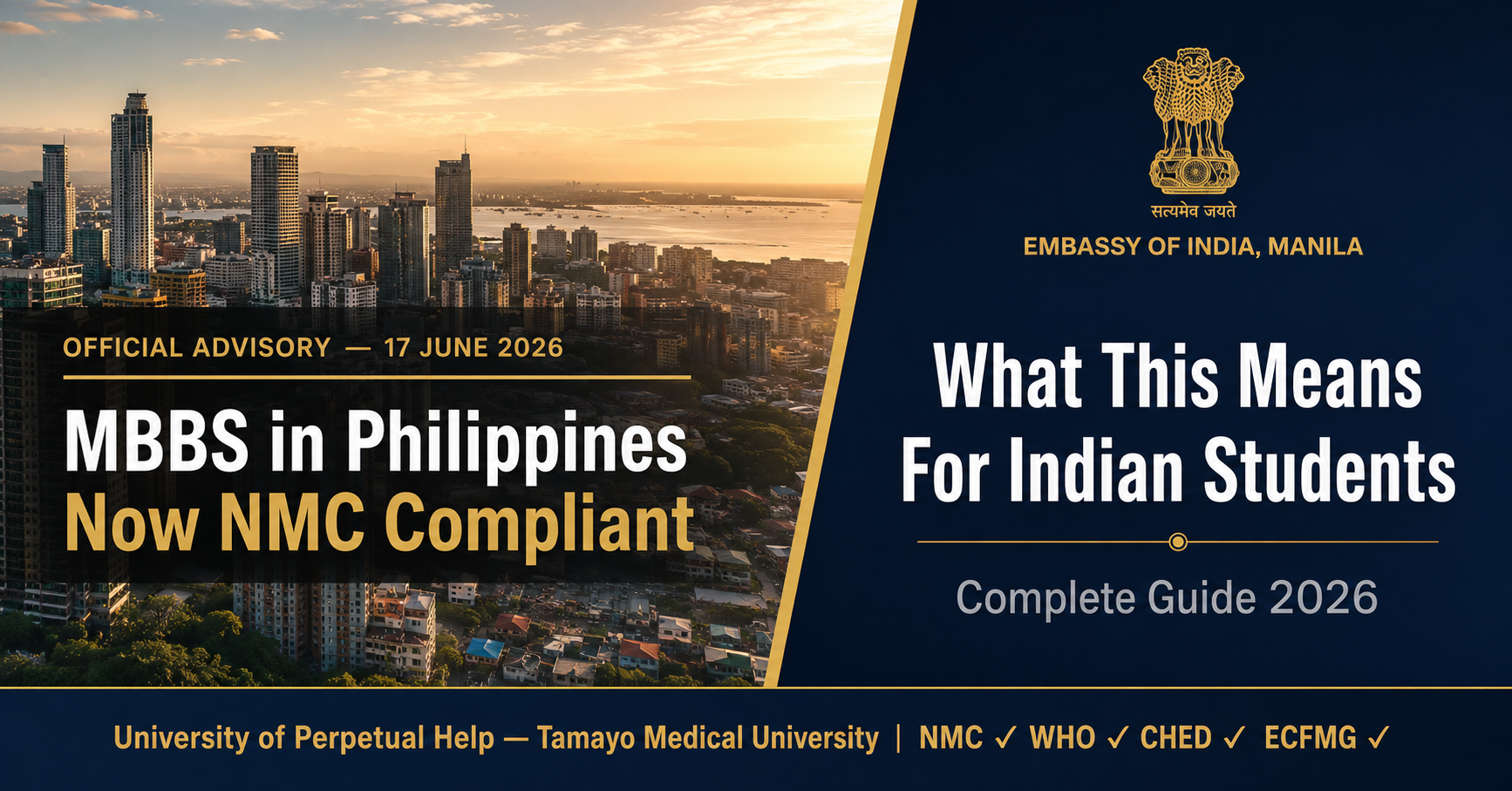
Type 2 — NMC Curriculum Compliant: The college’s specific programme structure — duration, subjects, medium, internship — has been verified against the four compliance criteria specified in the Embassy of India, Manila’s advisory dated 17 June 2026.
The distinction matters enormously. <cite index=”24-1″>From 2021 onwards, NMC has made strict rules for MBBS abroad. Students must choose a medical college in Philippines that follows all NMC guidelines to study MBBS abroad and return to work in India.</cite>
The four compliance criteria confirmed by the Embassy of India, Manila, on 17 June 2026 are:
- 54-month MD programme duration (excluding pre-medical BS phase)
- Mandatory subjects per NMC Schedule-I notification of 18 November 2021
- 100% English medium instruction
- 12-month supervised internship at the same institution or its officially attached hospital
Where Tamayo Medical University stands: Tamayo Medical University (UPH-DJGTMU) is both NMC listed AND curriculum-verified. The Embassy of India, Manila, advisory dated 17 June 2026 — based on a CHED letter of 8 May 2025 and Philippine House Resolution No. 73 of 11 March 2026 — confirms that CHED-recognised institutions including Tamayo Medical University meet all four compliance criteria. This is the highest level of NMC validation currently available for any Philippines medical college.
What to ask any other Philippines medical university: “Can you show me written confirmation that your specific MD programme — excluding the BS phase — is 54 months and covers all NMC Schedule-I subjects?” If they cannot produce this in writing, you are relying on assumption, not confirmation.
Criterion 2 — Real Cadavers vs Plastic Dummies: Why This Question Reveals Everything
This is the most underasked question in MBBS abroad counselling — and one of the most revealing.
Ask any Philippines MBBS college admissions office: “Do students perform anatomy dissection on real cadavers — or on plastic models and digital simulations?”
The answer tells you two things simultaneously. It tells you about the institution’s genuine commitment to medical training infrastructure. And it tells you about the counsellor or institution representative’s willingness to answer difficult questions honestly.
Why does cadaver vs dummy matter clinically?
Human anatomy is three-dimensional, variable, and individual. No two cadavers are identical. Fascia planes, nerve variations, vessel anomalies, organ positioning differences — none of these appear in a plastic model or a digital simulation. A medical student who has only ever studied anatomy on a standardised dummy enters clinical rotations with a fundamentally different — and incomplete — understanding of the human body compared to a student who has performed real dissection.
This is not a theoretical concern. It is a documented contributor to clinical reasoning deficits in graduates from institutions that prioritise infrastructure cost savings over genuine anatomical education. And it directly affects FMGE performance in the anatomy and clinical sciences sections.
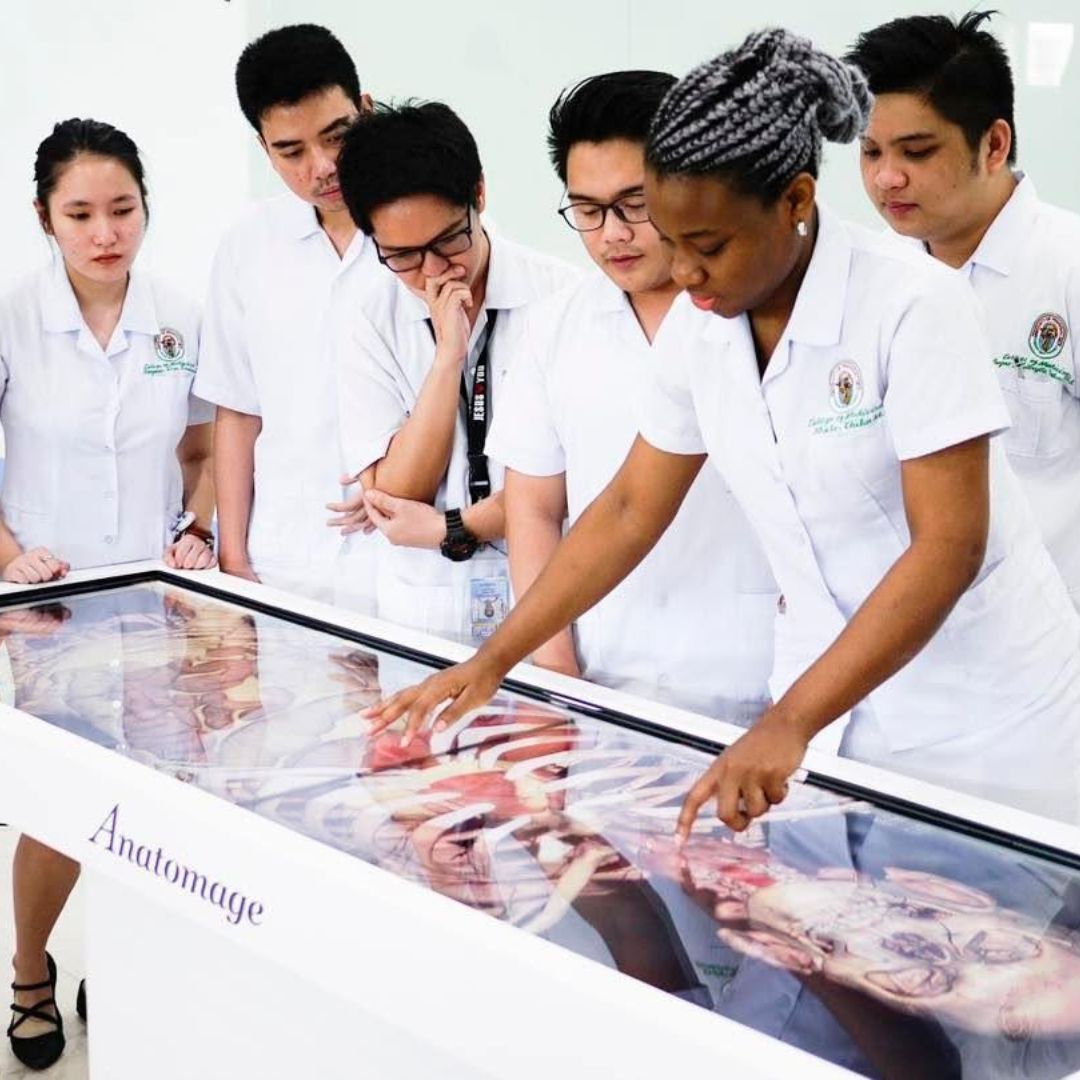
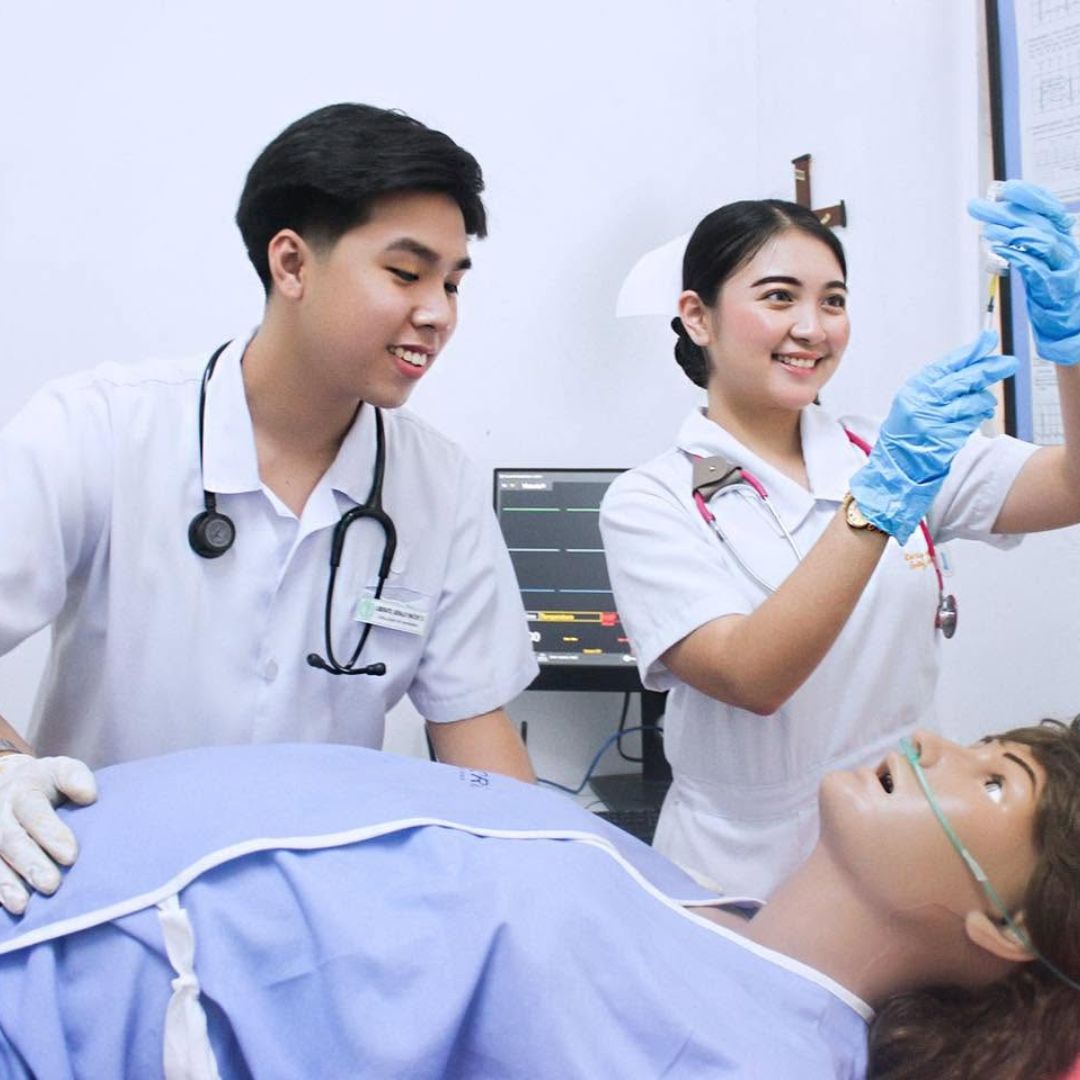
Where Tamayo Medical University stands: Tamayo Medical University maintains a dedicated Anatomy Museum and Dissection Hall with full cadaver dissection facilities. Students at this Philippines medical university perform real cadaver anatomy — not dummy-based approximation. The institution also maintains a Clinical Simulation and Skills Laboratory with procedural training mannequins — not as a replacement for cadaver work but as an additional layer of clinical skills preparation before ward entry.
What to ask: “Does your university have a cadaver dissection hall? Are all MD students required to complete cadaver dissection as part of their anatomy curriculum?” Get the answer in writing.
Criterion 3 — Hospital Patient Volume During Internship: The Number No Website Publishes
This is the criterion that most Philippines medical university comparison websites never include — because most institutions would rather not answer it.
Here is the underlying reality: a Philippines MBBS college that is affiliated with a hospital seeing 50 outpatient cases per day cannot provide meaningful clinical exposure for 200 interns simultaneously. The mathematics simply do not work. Students end up observing rather than participating. They watch procedures rather than performing them. They accumulate internship hours without accumulating clinical competence.
Patient volume and case mix diversity during internship are the two factors that most directly determine how clinically confident a graduate is when they return to India. A graduate who has seen 50 real clinical cases across diverse specialties during internship is categorically better prepared than one who has watched 500 cases passively.
FMGE pass rate is the ultimate proof of quality — high pass rate equals better teaching and better preparation. Hospital affiliations with real clinical exposure matter significantly in choosing a Philippines medical college.
Where Tamayo Medical University stands: Tamayo Medical University’s clinical training programme operates across 5 affiliated hospitals in Metro Manila with a combined capacity of over 2,020 clinical beds:
| Hospital | Beds | Specialisation |
|---|---|---|
| Perpetual Help Medical Center Biñan (on-campus) | 250 | General — teaching hospital |
| National Center for Mental Health | 450 | Psychiatry specialist |
| San Lazaro Hospital | 420 | Infectious diseases specialist |
| Jose R. Reyes Memorial Medical Center | 600 | General — largest affiliated |
| Quirino Memorial Medical Center | 300 | General government hospital |
Metro Manila’s hospital network serves one of Southeast Asia’s most populous urban regions. The patient volume, case diversity, and specialty range across these five hospitals give Tamayo Medical University students a clinical caseload that directly mirrors the breadth of cases tested in FMGE’s clinical reasoning sections.
What to ask: “How many patients does your primary affiliated hospital see per day in outpatient and inpatient departments combined? What is the student-to-patient ratio during internship rotations?” If a Philippines MBBS college cannot answer this specifically, the clinical exposure question is unanswered.
Criterion 4 — FMGE Pass Rate: How to Get It in Writing Before You Sign
The FMGE pass rate of a Philippines medical university is the single most important number in the entire MBBS abroad decision — and it is the number that is most frequently obscured, approximated, or simply not provided.
<cite index=”23-1″>37+ NMC approved universities exist in Philippines with an MD program — but the FMGE and NExT pass rate is the ultimate proof of quality.</cite>
Here is why this number matters and why you must get it in writing:
India’s FMGE examination tests graduates across all NMC Schedule-I subjects — the same subjects that should have been the core of the MD curriculum. A Philippines MBBS college with a genuinely NMC-aligned curriculum, taught in English, with real clinical exposure, will produce graduates who are better prepared for FMGE than a college that teaches a looser curriculum in a partially English environment with limited hospital exposure.
The FMGE pass rate is the output measure that reflects all these input variables simultaneously. It is the most honest signal of educational quality available.
What a good FMGE pass rate looks like: The national average FMGE pass rate for Philippines graduates fluctuates — figures of 20–30% are commonly cited for the Philippines collectively. However, top-performing institutions within the Philippines consistently outperform this average. A college that cannot show you batch-specific FMGE data is not confident in its own outcomes.
Where Tamayo Medical University stands: Tamayo Medical University’s NMC Schedule-I aligned curriculum — covering all mandatory subjects in 100% English medium, reinforced by Metro Manila hospital clinical exposure — is designed to produce graduates who are examination-ready from the structure of the programme itself, not from post-graduation cramming. Request current FMGE pass rate data from Neolife Education at +91 7998899777.
What to ask — and how to ask it correctly: “What is the FMGE pass rate for the last three graduating batches from your institution specifically — not the Philippines national average?” Request this in writing via official email. A counsellor or institution that answers verbally but refuses written confirmation is giving you information they are not prepared to stand behind.
Criterion 5 — Hostel: In-Campus vs Off-Campus for Indian Students
This criterion sounds operational but has deep safety and academic implications that most families only understand after their child has already arrived.
In-campus hostel: The student lives within the university compound. Security is managed by the university. Access is controlled. Emergency response is faster. The student’s commute to lectures and clinical departments is measured in minutes or steps. Community life with other Indian students happens organically. The university takes direct responsibility for the living environment.
Off-campus hostel: The student commutes to campus — sometimes across unfamiliar routes in an unfamiliar city. Security is managed by a third party. Emergency response goes through the building management, not the university. Community formation is harder. And in a country where most Indian students have never lived abroad before, the adjustment to an off-campus environment adds a layer of daily logistics that consumes energy that should be going to medicine.
<cite index=”26-1″>Indian student community provides language comfort, cultural support, and senior guidance — and this community is most effective when students are living together on or near campus.</cite>
Where Tamayo Medical University stands: Tamayo Medical University provides in-campus hostel accommodation with separate wings for boys and girls. The hostels operate with 24/7 CCTV surveillance and dedicated security personnel. Students live within the university environment — supervised, safe, and within the community that supports academic performance. The on-campus location means that the walk from hostel room to lecture hall is measured in minutes, not commutes.
What to ask: “Is the student hostel physically located within the university campus boundary? Who manages hostel security — the university or a third-party building management company?” If the answer is off-campus or third-party managed, understand what that means in practice before committing.
Criterion 6 — Indian Food: Daily vs Occasional (Why This Matters More Than You Think)
This is the criterion that generates the most polite dismissal from medical education advisors — and the most heartfelt gratitude from students who experienced a college where it was done right.
Indian students in the Philippines spend six years abroad. That is approximately 2,190 days. The food they eat on each of those days affects their energy level, concentration, mood, immune system, and overall wellbeing. This is not sentiment — it is physiology.
A student who eats familiar, nutritious food consistently performs better academically than a student who spends mental energy navigating unfamiliar food options, experiences gastrointestinal issues from dietary adjustment, or loses appetite from food homesickness. These are not edge-case outcomes — they are common in the first year of overseas study, and they are almost entirely preventable with the right institutional food provision.
The critical distinction is daily vs occasional:
An Indian Mess that operates three days a week is not the same as an Indian Mess that operates every day. A nearby Indian restaurant is not the same as an on-campus Indian Chef. Families should ask specifically: “Is Indian food available on campus, prepared by an Indian Chef, on every day of the academic week — not occasionally?”
Where Tamayo Medical University stands: Tamayo Medical University operates an Indian Mess on campus staffed by an Indian Chef serving authentic North Indian and South Indian meals every single day. Not twice a week. Not on request. Every day. From the first week of arrival, Indian students at this Philippines medical university eat familiar food without compromise. This single operational detail has been cited by Indian alumni as one of the three factors that made the biggest positive difference to their first year of study.
What to ask: “Is the Indian Mess on campus? Is it open every day? Who cooks — an Indian Chef or Filipino staff cooking Indian recipes?” The specific answer matters.
Criterion 7 — Manila vs Provincial Location: Why Metro Manila Clinical Diversity Wins
The Philippines has excellent Philippines medical universities in multiple cities — Cebu, Davao, Iloilo, and Manila are the most common MBBS destinations. For Indian students specifically, location matters in ways that go beyond convenience.
Why Metro Manila produces better clinical outcomes:
Metro Manila is the Philippines’ largest metropolitan region and its primary healthcare hub. The city’s hospitals — government and private — serve a patient population of over 13 million people across the National Capital Region. The disease burden in Manila reflects the full complexity of Southeast Asian health patterns — from infectious diseases (tropical, respiratory, vector-borne) to non-communicable diseases (cardiovascular, metabolic, neurological) to trauma and obstetric emergencies at volumes that smaller provincial cities simply cannot match.
For Indian students who will return to practice in India — a country with equally complex and diverse health patterns — Metro Manila’s clinical diversity is genuinely preparatory in a way that a smaller provincial hospital network is not.
Additionally, Metro Manila’s English-speaking environment is the most complete in the Philippines. In every hospital, every ward, every clinical note, and every consultant interaction — English is the operating language. This eliminates any remaining ambiguity about clinical medium that could theoretically exist in more provincial settings.
Where Tamayo Medical University stands: Tamayo Medical University is located in Biñan, Laguna City — within Metro Manila — providing access to five major hospitals across the metropolitan region with over 2,020 clinical beds. The on-campus Perpetual Help Medical Center Biñan is supplemented by four major Manila hospitals — Jose R. Reyes Memorial Medical Center (600 beds), National Center for Mental Health (450 beds), San Lazaro Hospital (420 beds), and Quirino Memorial Medical Center (300 beds).
This hospital network cannot be replicated in a provincial location — and it is the clinical foundation that produces the FMGE-ready graduates that the Tamayo Medical University track record reflects.
Where Tamayo Medical University Stands on Every Criterion — The Scorecard
| Criterion | What to Look For | Tamayo Medical University |
|---|---|---|
| NMC Compliance | Embassy-confirmed, not just listed | ✅ Confirmed — Embassy of India Manila, 17 June 2026 |
| Cadavers vs Dummies | Real cadaver dissection hall | ✅ Anatomy Museum and Dissection Hall with full cadaver facilities |
| Hospital Patient Volume | Named hospitals, bed count, clinical ratio | ✅ 5 hospitals, 2,020+ beds, Metro Manila diversity |
| FMGE Pass Rate | In writing, batch-specific | ✅ NMC Schedule-I aligned — request data: +91 7998899777 |
| Hostel | In-campus, university-managed, 24/7 security | ✅ In-campus, separate boys/girls, 24/7 CCTV |
| Indian Food | Daily, on-campus, Indian Chef | ✅ Indian Mess daily, Indian Chef, North and South Indian |
| Location | Metro Manila for clinical diversity | ✅ Biñan, Laguna — Metro Manila |
Why Tamayo Medical University Is The Standard for Philippines Medical Universities
Against the backdrop of more than 12,000 Indian students enrolling every year in Philippines MBBS programmes, the choice of institution is the single most consequential decision in the entire MBBS abroad journey. And the framework above shows why Tamayo Medical University consistently emerges as the benchmark when Indian families apply genuine rigour to the decision.
The university has been producing physicians since 1976. It was established by Dr. Jose G. Tamayo and Dr. Josefina Laperal Tamayo with a founding mission that has not changed in 47 years — to form compassionate, clinically excellent physicians who serve their communities. Its “Home of Board Topnotchers” reputation was earned through consistent examination outcomes, not declared through marketing.
The June 2026 NMC compliance confirmation from the Embassy of India, Manila, does not make Tamayo Medical University a stronger institution than it was before that advisory. It simply provides Indian families with the official documentation that confirms what the institution’s track record already demonstrated.
When families apply the 7-criteria framework to Tamayo Medical University — cadavers, patient volume, FMGE data, in-campus hostel, daily Indian food, Manila location, and Embassy-confirmed NMC compliance — every criterion is met.
That combination, at MD tuition of $2,375 per semester with no donation fee, is why Tamayo Medical University is the strongest Philippines medical university option for Indian MBBS aspirants in 2026.
The 10 Questions Every Indian Family Must Ask Before Choosing Any Philippines Medical University
Use this as your checklist when evaluating any Philippines MBBS college — including Tamayo Medical University. Every institution should be able to answer every one of these in writing:
Question 1: Is the college CHED-recognised? Verify at ched.gov.ph.
Question 2: Is the college on the current NMC India list? Verify at nmc.org.in — not a cached 2022 version.
Question 3: Is the MD programme exactly 54 months — excluding any pre-medical BS phase? Get this in writing.
Question 4: Does the curriculum cover all subjects in NMC Schedule-I of the 18 November 2021 notification — Anatomy, Physiology, Biochemistry, Pathology, Microbiology, Pharmacology, Forensic Medicine, Community Medicine? Request curriculum document.
Question 5: Does the university use real cadavers for anatomy dissection — or plastic dummies and digital models only?
Question 6: What is the FMGE pass rate for the last three graduating batches from this specific college — not the Philippines national average? Request in writing.
Question 7: How many patients does the primary affiliated teaching hospital see per day across all departments? What is the student-to-patient ratio during internship?
Question 8: Is the hostel in-campus? Who manages security — the university or a third party?
Question 9: Is Indian food available on campus every day? Is it prepared by an Indian Chef?
Question 10: What happens if I fail FMGE — are there any institutional support resources, or am I on my own after graduation?
Conclusion — Choose the Philippines Medical University That Passes Every Test
The Philippines has outstanding Philippines medical university options for Indian students in 2026. The Embassy of India, Manila, has now confirmed that CHED-recognised institutions provide NMC-compliant medical education. That is an important green light.
But a green light is not a route map. It tells you the road is open — not which road to take.
The 7-criteria framework in this blog is your route map. It gives you the specific questions that separate the Philippines MBBS colleges that will produce examination-ready, clinically confident Indian doctors from those that will produce graduates who are technically qualified but inadequately prepared.
Tamayo Medical University — University of Perpetual Help, Biñan, Laguna, Metro Manila — meets every criterion. 47 years of institutional history. Embassy-confirmed NMC compliance. Real cadaver anatomy. 5 Metro Manila hospitals with 2,020+ clinical beds. In-campus hostel. Indian Chef daily. MD tuition $2,375 per semester. No donation. No capitation.
2026 admissions are open. NEET qualified Indian students are eligible to apply now.
📲 WhatsApp “TAMAYO” to +91 7998899777 📞 Call Neolife Education — Free Philippines Medical University Guidance ✍️ Download the 2026 Philippines MBBS University Comparison Guide PDF